Gita is about a 90 minute conversation between Krishna and Arjuna, before the battle of Kurukshetra started, that Sanjaya narrated. It is a conversation that was born out of the fear and confusion of a warrior (Arjuna) who froze at the prospect of leading the biggest ever carnage on any battlefield in India. Perhaps, even the world.
Gita has 18 chapters dedicated to the most enlightening conversation in history of humanity, before an 18-day battle involving 18 armies (11 armies of Kauravas, and 7 armies of Pandavas). Gita has 700 verses, of which 574 are spoken by Krishna, 84 by Arjuna, 41 by Sanjaya, and 1 by Dhritrashtra.
Gita is not a rule book. It is not a book that attempts to “fix” the world. Rather, it is an “exposition” of this world. Krishna, who is a friend of Arjuna, was his charioteer. Krishna engages Arjuna in a conversation right before the battle, to make him understand the concept of karma, gyana, and bhakti, and the interplay between them.
Post enlightenment, Arjuna engages his cousins, uncles, gurus, and mentors in a battle where he loses his son and most of his loved ones; all for righteousness and to uphold dharma. Annie Besant said, “He who can understand the complexity of Gita can understand likewise the complexity of the world…”. She further says, “He who thus reads the Gita in human history can stand unshaken amid crash of the breaking worlds.”
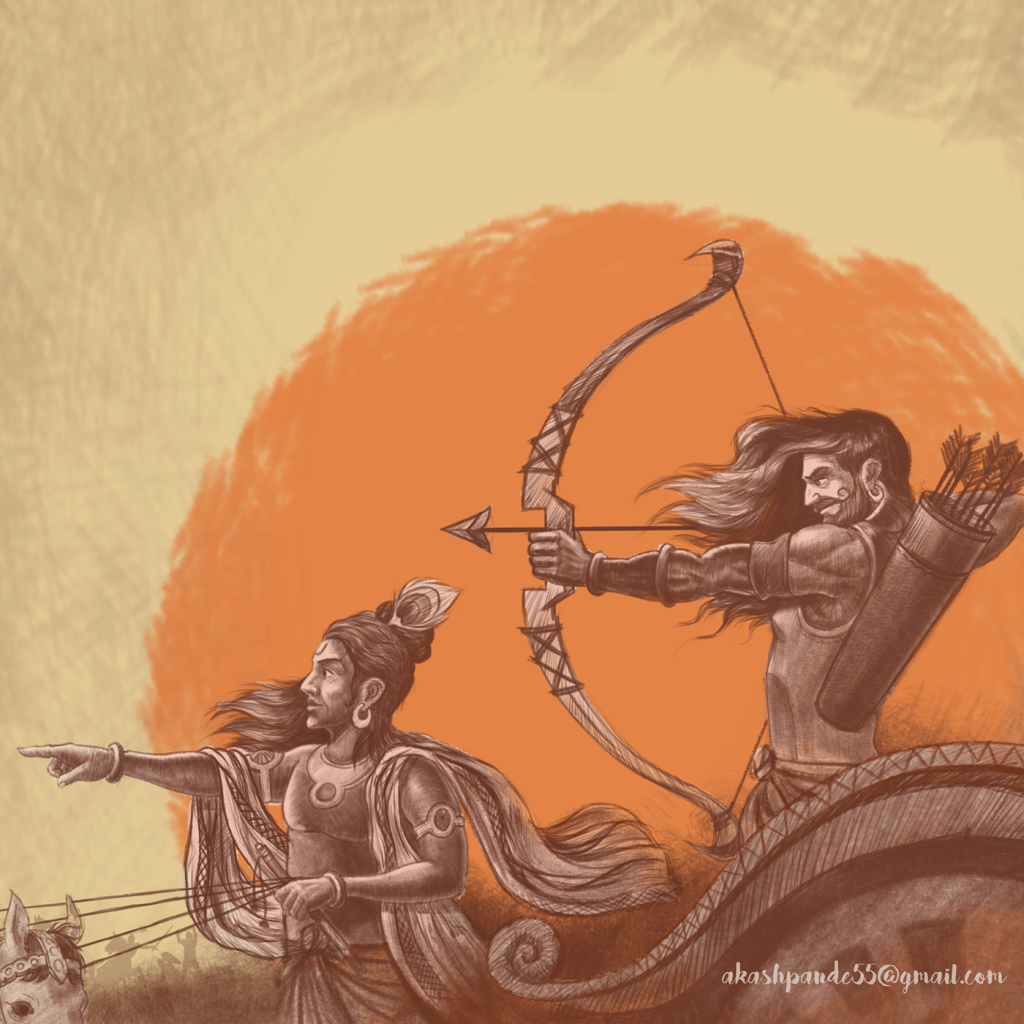
Gita is a discourse for a man torn between his reality and his possibilities. Prof. Chakravarthi Ram-Prasad describes Gita as a treatise on “How to be in the world, without being of the world”. Jessica Frazier described Gita as a “doctrine of knowledge, action, love, and renunciation”. It settles some long standing questions – “Why is this world never perfect?”, “Can we get rid of evil?”, “Is violence necessary?”, “Why do we suffer?”, or even, “Do I have to work?”. Swami Nikhilananda explains in Shankaracharya’s interpretation of Gita, “Man is understood as an integral whole whose activities and feelings are not to be departmentalized.”
As per Swami Bhoomananda Tirtha, “Bharat is distinguished for its recurring fights between virtue and vice.” Bhagavad Gita is the most elaborate and comprehensive encapsulation of this timeless and inescapable assortment of the two.
“Modern science recognizes the process of the evolution of man through gradual transformations, from the lowest forms to the highest. But it leaves the most vital step – the ethical or moral development of man – completely untouched. Modern science avoids the task of the accountability of man’s virtues and vices; the ancient Rishis addressed these questions in a meaningful way. Modern science has not even attempted to find what happens to man after his physical death; Hindu philosophy establishes the very vital link of man from one birth to another, through eons of life cycles. Modern science appears unconcerned with the very purpose of life; Hindu Rishis considered this to be the most pertinent question.” [Essence of Hinduism: Path of Ancient Wisdom. Dr. Hiro G. Badlani]
Bhagavad Gita, literally, translates to “God’s Songs”. It is a book that marks the boundary between Vedic Hinduism and Puranic Hinduism. That is because for the first time in itihaas, the concept of a Vedic God is morphed into a Puranic God; the unseen and the formless can now be seen as a human being in Krishna.
 धार्मिक छवियाँ
Excellent narration of The Holy Gita. It is an excellent introduction to some one who has no clue or good information for those who has some idea about it. Should you say Lord Krishan On the second line?
LikeLike