To call Guru Nanak a religious leader is a modern travesty. He was not. What he is seldom viewed as is one the greatest philosophers of the world, ever in history. He got no divine revelations, and gave no commandments. Rather, he listened deeply to the saints and the mystics of his time, as many as he could find, as far as he could travel.
Nanak’s genius was to question and think deeply about everything he heard—sacred or profane, native or foreign, mundane or profound—and come to his own conclusions. That he did with utmost integrity and reached conclusions that were not only the need of the time, but would also grow into the beacon to a tumultuous world in centuries to follow.
In his sikhi the guru preached the simplest definition of divinity—a mind with its doors open to integrity, truth, and courage—a mind that anyone could cultivate at any stage of life, across genders and geography, irrespective of the socio-political landscapes, and without institutional sanctions.
He refined his teachings through his interactions with diverse communities. That he did for 28 years of his life traveling as far as Tibet, Sri Lanka, and Iraq.
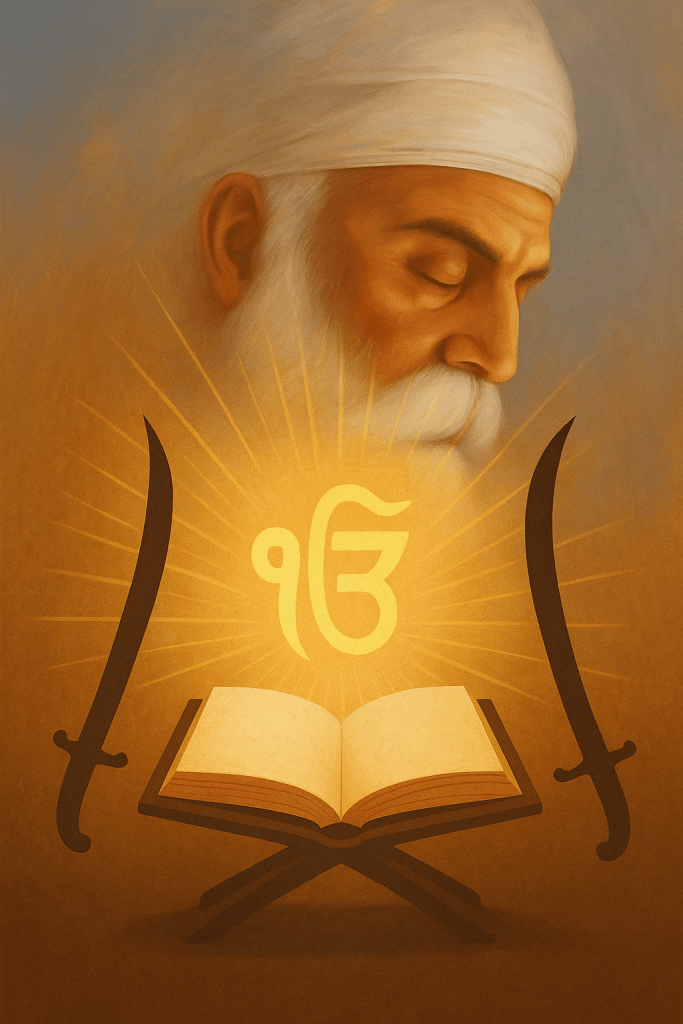
Such was the integrity of the Guru that he admonished without discrimination—whether it was the practice of enforced sati, the destruction of temples, or the cruelty and barbarity of invading rulers such as Babar. Paupers, peasants, and padshahs, all got equal treatment from him.
In the final two decades of his life, he chose to established his community in Kartarpur, which he taught, guided, and nurtured with moral clarity. When time came to choose his successor, he picked neither of his two sons. Rather, he chose who he thought understood his philosophy the most and would serve the sangat selflessly—Guru Angad was not a blood relative of Guru Nanak.
Nine more Gurus came after Nanak, who enriched Nanak’s philosophy through service, meditation and questioning. They expanded the sikhi, developed the gurmukhi script, established centers of learning, birthed festivals, built an abode for Granth Sahib and the pilgrims in Amritsar, and eventually created the Khalsa. But in between they had to go above and beyond their service to mankind and throw themselves, along with their families and followers, in the armed defense of dharma.
The leadership of gurus evolved from pure reflection to incorporating action. In one of the darkest chapters of India’s occupation, ruthless persecution and plunders, the gurus kept the flames alive and defended the soul of Bharat through the most inhumane trials they were put through. Betrayals, beheadings, and butchery of the intolerant Lodi and Mughal rulers did not shatter the gurus or their followers. Rather, the barbarism they were subjected to strengthened their resolve and strategy over time, which ultimately birthed a martial front—an identity that was formalized as a living identity in the Khalsa. The philosophy that sought to erase inequality and indignity, finally found the protection it needed. What an appropriate and beautiful gift from a guru to humanity, a couple of centuries down the line.
What never changed over the centuries are the core principles of sikhi: to remember Wahe Guru, to treat all human beings as equals, and to live in the spirit of service to humanity. While the physical appearance of Sikhs gives them a distinct identity, what is less obvious is the impact of sikhi on the culture of Bharat. The community langar, for instance, gave the entire region of Punjab and Sikhs an unmistakeable and unparalleled identity, which became an inspiration to the rest of the nation. (It is noteworthy that while Buddha chose to seeks alms and the sangha never cooked, Sikhs on the other hand decided to feed the world, and langars became the most visible identity of sangats.)
That is the enduring philosophy of Nanak, which continues to inspire the dharma of equality, service, and remembrance in millions around the world; a philosophy that we need more than ever today, which the Sikhs continue to give throughout the world.
 धार्मिक छवियाँ