There are over 1800 teertha sthal (sacred places) in India. The Mahabharata alone refers to about 330 teertha, and outlines a clockwise circuit through those from Pushkar to Prayag, with Pushkar being the oldest. Most of the teertha sthal are situated alongside the rivers. That is because bathing, in what is considered as sacred waters, is an important aspect of a dharmic’s life. But a teertha can be a river, mountain, region, or even a forest. In some cases, it is a spot in a city, along with other similar teertha spots in vicinity.
So, why do we do a teertha yatra (pilgrimage)?
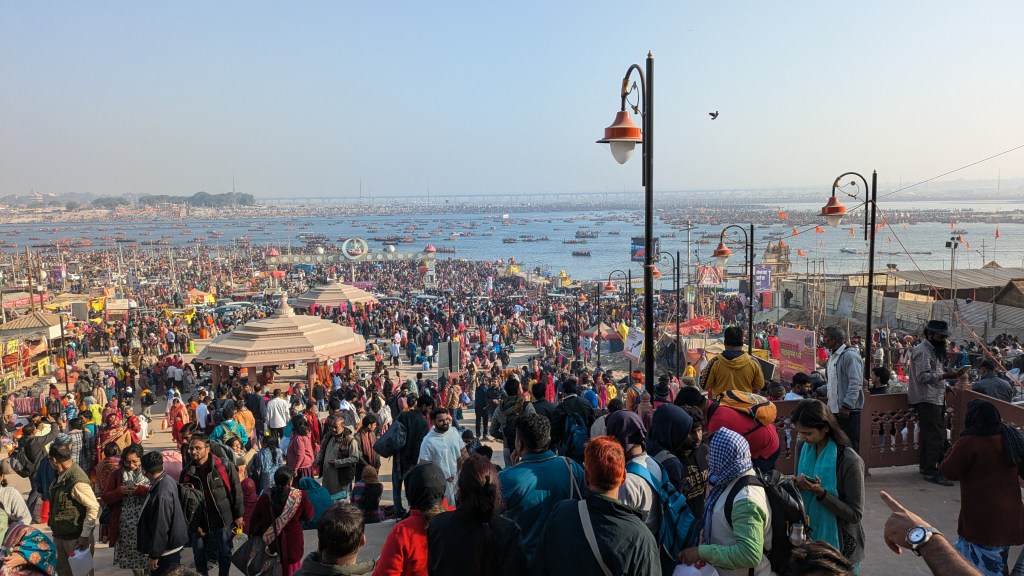
People say that visiting a teertha does magic. That, for example, a dip in Ganga at Prayagraj or Varanasi cleanses one of their misdeeds. Why are some places like Multan, which was the most important teertha after Pushkar, not a teertha anymore? Why did the Mahabharata not mention Rameshwaram, Tirupati, Badrinath, or Kedarnath, which are considered teertha now?
Generally speaking, two reasons exist for a teertha – life events such as death or mundan (head tonsure) of a child, or vows and ceremonies for the deities. Most teertha are identified with a particular deity. For example, Pushkar is identified with Brahma. Amarnath is associated with Shiva. Going to a teertha, therefore, is getting a deeper identity with a deity.
Every teertha is associated with a story of a deity that is symbolic of an ideal in life. Every teertha is a bustling sangha of like-minded individuals – an opportunity to learn and grow – watching and listening to others in the sangha. Learning from the learned is the goal. This is why Multan after the desecration by the Muslims ceased to be a teertha and Somnath never managed to become a teertha, but Badrinath, Kedarnath, and Tirupati emerged as a teertha later. Sanctity and sangha are two preconditions for a place to be a teertha. But the true measure of a teertha lies not only in its sanctity or community, but in the mind of the pilgrim who approaches it.
A teertha is a sacred opportunity to observe and examine the desires and attachments of the mind. There are desires of attainment – wealth, fame, physical, etc. So are there attachments – family, objects, etc. Then there are desires that are spiritual in nature – to understand and find oneself, to identify the purpose of life, and to lead a disciplined life that helps in attainment of the goals of a spiritually purposeful life. To a mind consumed in self-enquiry, self-cleansing every step in that direction is just as important as a crack or an overhang is to a free-climber. While teertha is a culmination, there are several of these cracks and overhangs that one encounters leading up to a decision to do a teertha. That is where the micro pivots on one’s life have always been.
Whether that is true or not depends on one’s state of mind. The secret sauce is neither the act of taking a dip in Ganga, nor the travel to any other teertha sthal for that matter.
Like many other endeavors of life an outcome is not guaranteed. However, a positive outcome is more likely to be achieved if there has been a preparation behind it. It is that preparation that is slowing chipping away the unfriendly mind, and training the friendly one. Whether someone goes to a teertha or not, the preparation in itself is liberating. Shedding the unnecessary, unproductive, and unfriendly mind is liberation in itself. That dip in Ganga or the sight of Kailash is the culmination and a self-declaration of a resolve to purify the mind. That is the final cleansing. In fact, to a mind engaged in self-cleansing a teertha is a renewal and reenergizing of this mental discipline until the next teertha pilgrimage.
A teertha is a celebration of the slaying of the inner demons we all carry within. It is a celebration of the slaying of the corruption of our mind.
 धार्मिक छवियाँ